
Contaminated Land Public Registers
Contaminated land registers are required under Section 78R of Part 2A of the Environmental Protection Act 1990. It records formal regulatory actions taken by the Council in relation to contaminated land in respect of the Act.
What the register Includes:
- Remediation notices – legal notices requiring clean-up of contaminated land.
- Appeals against remediation notices.
- Remediation declarations and statements – documents outlining agreed remediation actions.
- Appeals against charging notices.
- Designation of special sites – sites regulated by the Environment Agency due to specific risks.
- Notifications of claimed remediation.
- Convictions for offences under Section 78M of the Act.
- Guidance issued under Section 78V(1) of the Act.
- Notice of revocation – record of withdrawal of a previous determination that land was contaminated.
What the register does not include:
- Historic land use data.
- Sites remediated through planning and development control processes.
Please note: the absence of a site from this register does not guarantee that the land is free from contamination. It may not have been assessed or may have been remediated through other processes.
What is Part 2A?
Part 2A of the Environmental Protection Act 1990 is a legal framework designed to address the most serious cases of land contamination in England. Its purpose is to ensure that land which poses an unacceptable risk to human health or the environment in its current use is identified and, where necessary, remediated.
Under Part 2A, land is formally determined as “contaminated land” only if:
- There is a significant possibility of significant harm (SPOSH) to human health or protected receptors, or
- There is significant pollution of controlled waters, or a significant possibility of such pollution.
This is assessed through a risk-based approach, considering whether a complete pollutant linkage exists (a contaminant, a pathway and a receptor).
Why some contaminated land is not on the register
Not all land with contamination falls under Part 2A. In fact, most contaminated sites in the UK are not dealt with under Part 2A because:
- The contamination does not pose a significant risk.
- Risks can be managed through planning and redevelopment controls when land use changes.
- Voluntary remediation by landowners or developers often addresses contamination without formal enforcement.
For example, a former industrial site may contain low levels of contaminants that do not present an immediate risk. If that land is redeveloped for housing, the planning system will require investigation and remediation to make it safe for its new use.
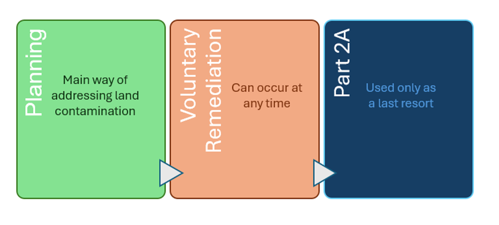
Part 2A is considered a “last resort” mechanism, used only when no other suitable solution exists and the risks are serious.
Other methods to address contamination
Most contaminated land issues are managed through:
- Planning and Development Control: Ensures land is suitable for its intended use before development proceeds.
- Voluntary Remediation: Landowners or developers may clean up land without formal enforcement.
Public Register for Telford & Wrekin Council - Contaminated Land (Part 2A, Environmental Protection Act 1990)
This register provides information on sites determined under Part 2A of the Environmental Protection Act 1990. It includes current determinations and notices of revocation where sites are no longer considered contaminated land or special sites.
Register of determinations and notices
Reference No.: 1
Site name: Agropharm
Address: Agropharm Ltd, Overley Hill, near Wellington, Telford, TF6 5HD
Status: Revoked – Site no longer considered contaminated land
Notice type: Notice of Revocation of Identification of Contaminated Land
Date of service: 18 July 2025
Legislation: Environmental Protection Act 1990 (EPA), Section 78QA
Easting: 360879
Northing: 310516
Explanatory note:
This notice confirms that the previous determination identifying the land as contaminated under Part 2A of the Environmental Protection Act 1990 has been revoked. The site is no longer classified as contaminated land or a special site as defined in the Act and is therefore not subject to any remediation requirements under Part 2A.
View the public register note - Agropharm (.pdf Size: 104Kb) .
Last updated : 13 February 2026